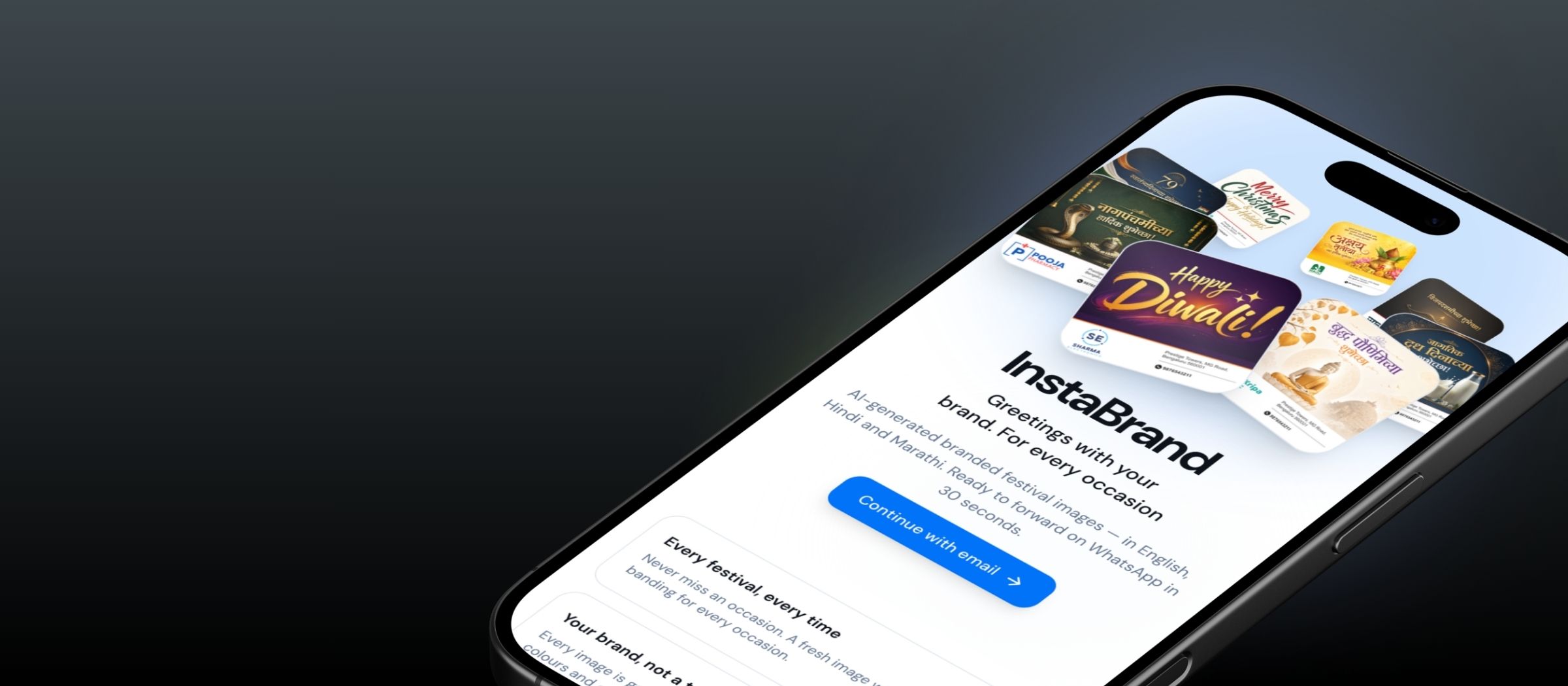
 Case Study
Building InstaBrand
A product designer, thinking like a full-stack builder — from idea to live product, solo. InstaBrand turns a small business owner's logo and a few details into festival-ready, on-brand posters for WhatsApp, in under a minute.
and build — end to end
into a real pipeline
real infrastructure
Not a Figma prototype — a live product.
I envisioned a product and built it — alone, end to end. Not a Figma prototype, a live product with real users, real payments, real infrastructure.
Doing that meant thinking and acting as product manager, strategist, architect, engineer, and marketer, not just designer.
Choosing the underserved segment, not the tempting one.
Every festival, Tier 2/3 Indian small business owners running marketing entirely through WhatsApp have to show up for customers with only bad options: re-forward a generic image, pay a designer (at least ₹20,000/year), or wrestle with Canva.
No existing tool serves "brand-consistent, zero-effort, WhatsApp-native." I considered an agency-facing pivot early, and rejected it — Canva Teams already owns that workflow. I chose to stay with individual owners, where the real white space was. The segment includes personal and political branding too, not just businesses.
01
Re-forward a generic image
Free, but generic, off-brand, and forgettable — no connection back to the business.
02
Pay a designer
At least ₹20,000 a year, but slow to turn around and an ongoing cost most owners can't justify.
03
Wrestle with Canva
Flexible and powerful, but demands design skill and time most owners don't have to spare.
Consistently on-brand — without a designer's price tag or Canva's learning curve.
InstaBrand exists to put small business owners on the same footing as brands twenty times their size — the same visual consistency, without hiring a designer or learning design tools. Set up your brand once — logo, name, contact — and every festival becomes a 30-second generate-and-send, not a scramble.
A designer costs real money every year and takes days to turn around. Doing it yourself in Canva or asking ChatGPT for an image saves that cost, but trades it for time — and neither replaces a trained eye, so results swing wildly from post to post. InstaBrand's bet is the opposite: fast, zero-skill, and reliably on-brand every time, at a fraction of what a designer costs.
That's also why InstaBrand is explicitly not a general design tool, and isn't competing with Canva on creative control. Feature requests pulling toward "more flexibility" were mostly declined to protect that promise.
Directed like a technical spec — not a demo.
Used Claude to think through the architecture and Lovable to build it — directing both like a technical spec, wiring together real production infrastructure.
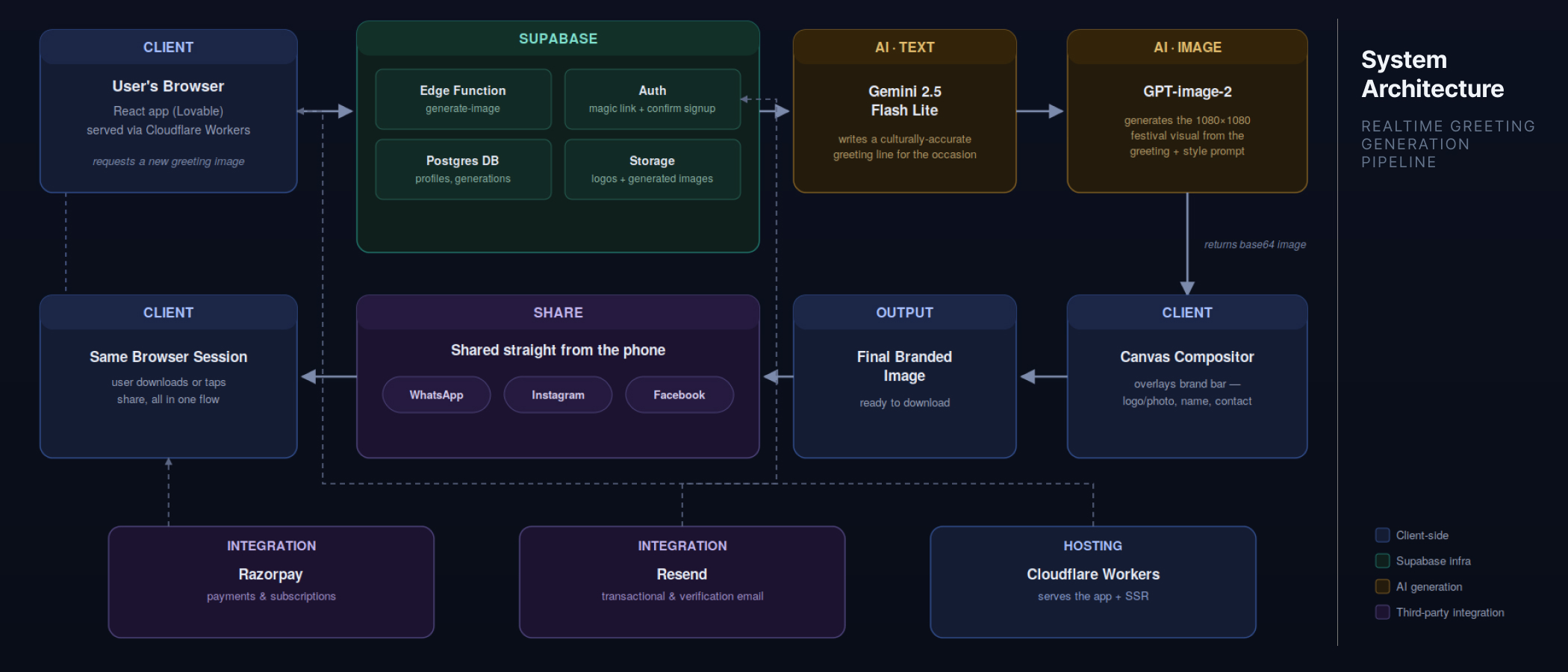
Architecture diagram — user → Supabase/edge function → Gemini + GPT-image-2 → Canvas compositor → final image
A real two-model pipeline: Gemini writes the greeting, feeds the image model
01

Razorpay
Payments and subscriptions.
02

Supabase
Auth, database, and file storage.
03

Resend
Verification and transactional email.
04


Gemini + GPT-image-2
A real two-model pipeline — Gemini writes the greeting, feeds the image model.
05

Browser Canvas
Composites logo, name, and contact onto the final image client-side.
06


Claude + Lovable
Claude to think through the architecture, Lovable to build it — directed like a technical spec.
Fast and simple — from onboarding to everyday use.
Every decision was built around one goal: this should never feel like using a design tool. Onboarding takes minutes, day-to-day use takes seconds, and nothing requires design skill or guesswork.
- Brand setup restructured into two steps: fill in details, then see a live preview before picking a style
- Style picker deliberately chosen over stacked cards or swipe — one large real result, easy to compare
- Text-based logo generator for users with no logo, with automatic script detection for Hindi/Marathi names
- Every new flow tested against real user data, not placeholder text
- Simplicity protected even when it meant saying no to "more options"
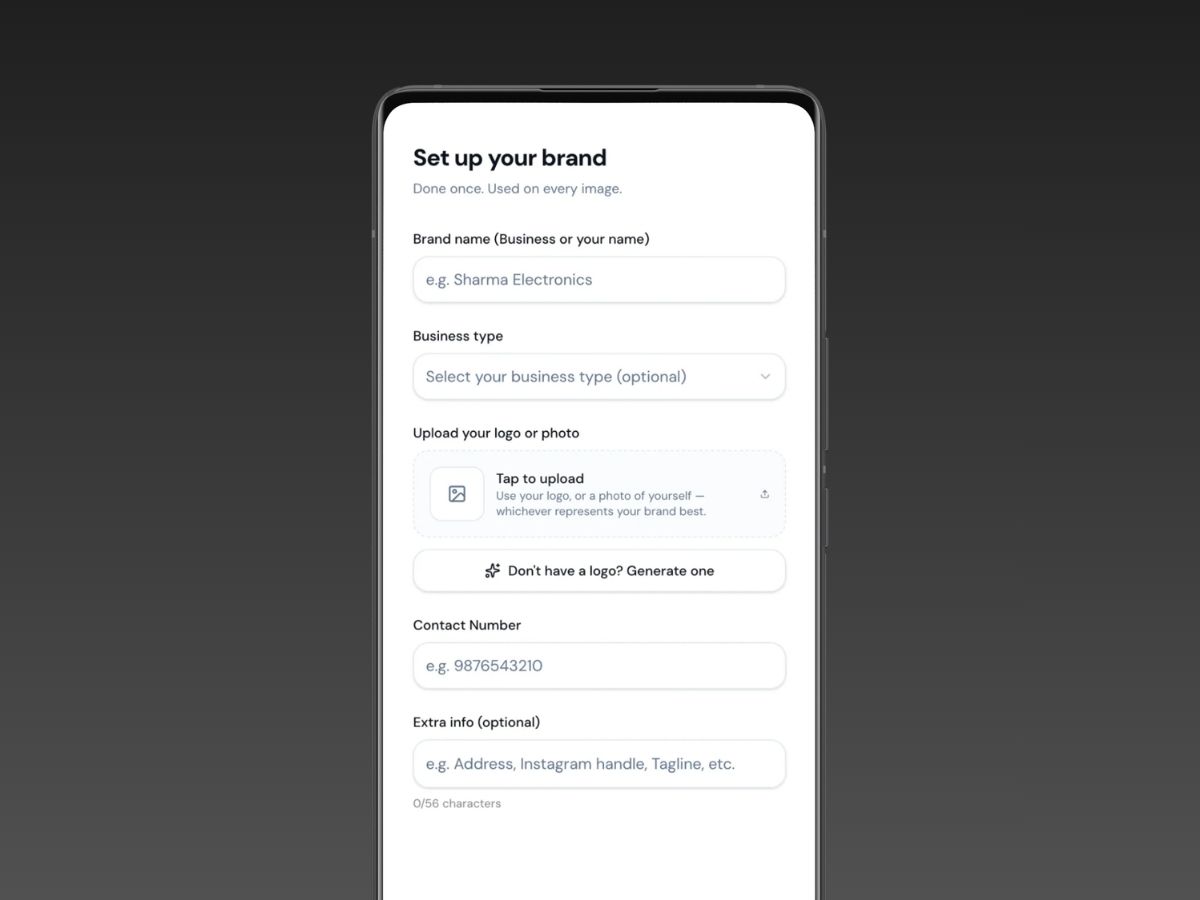
Brand setup and sign-off
One-time brand details and sign-off — set up your logo, name, and contact once, use them every time
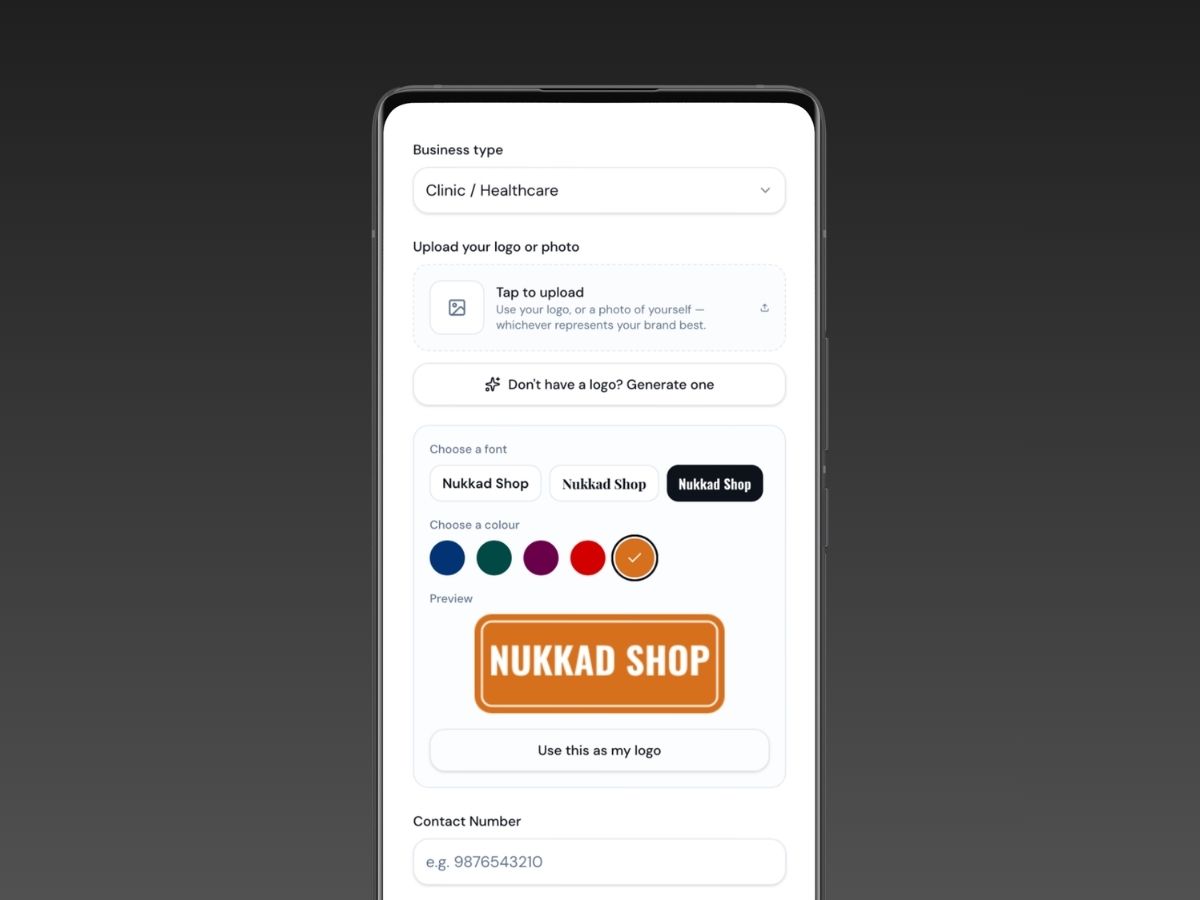
Text-based logo generator
Text-based logo generator for users with no logo, with script detection for Hindi and Marathi
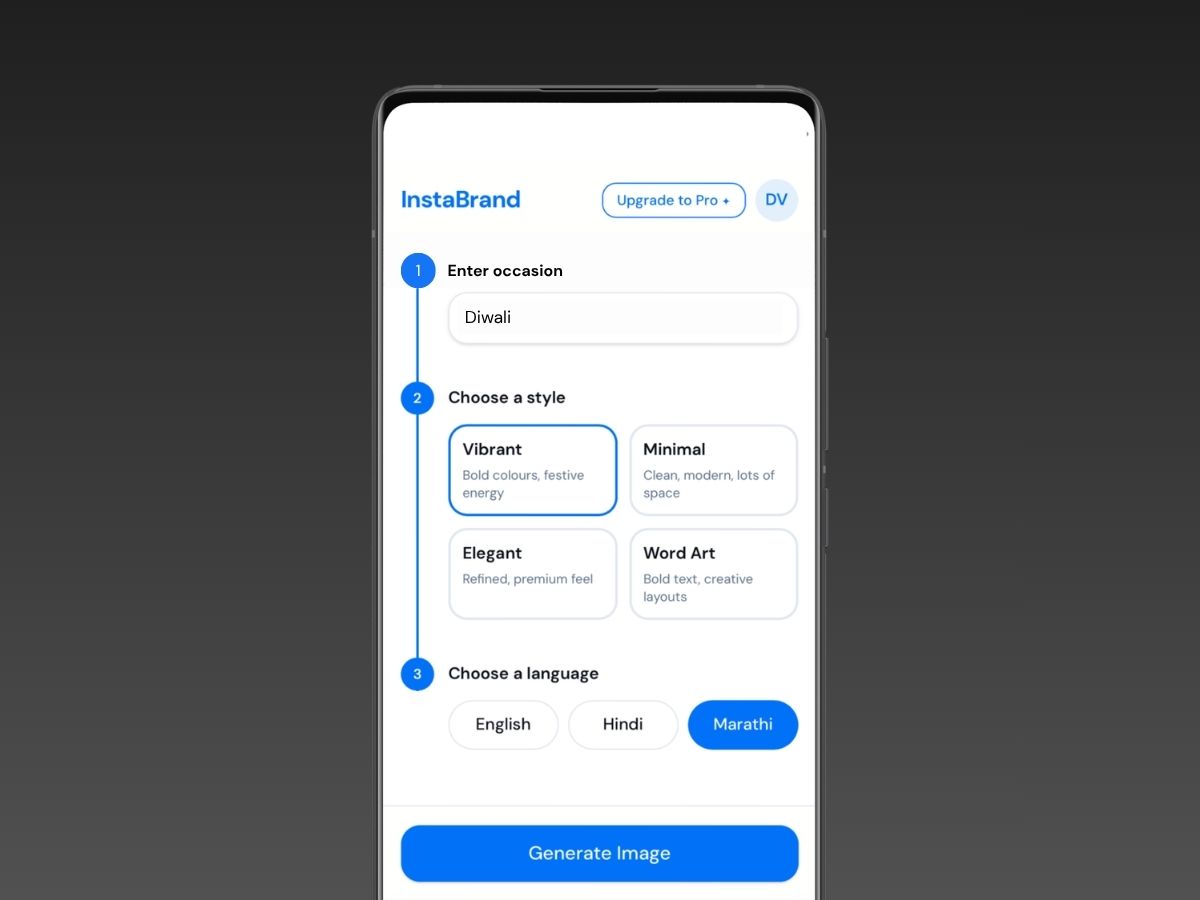
Greeting generation controls
Easy greeting generation controls — simple, guided, no design skill required
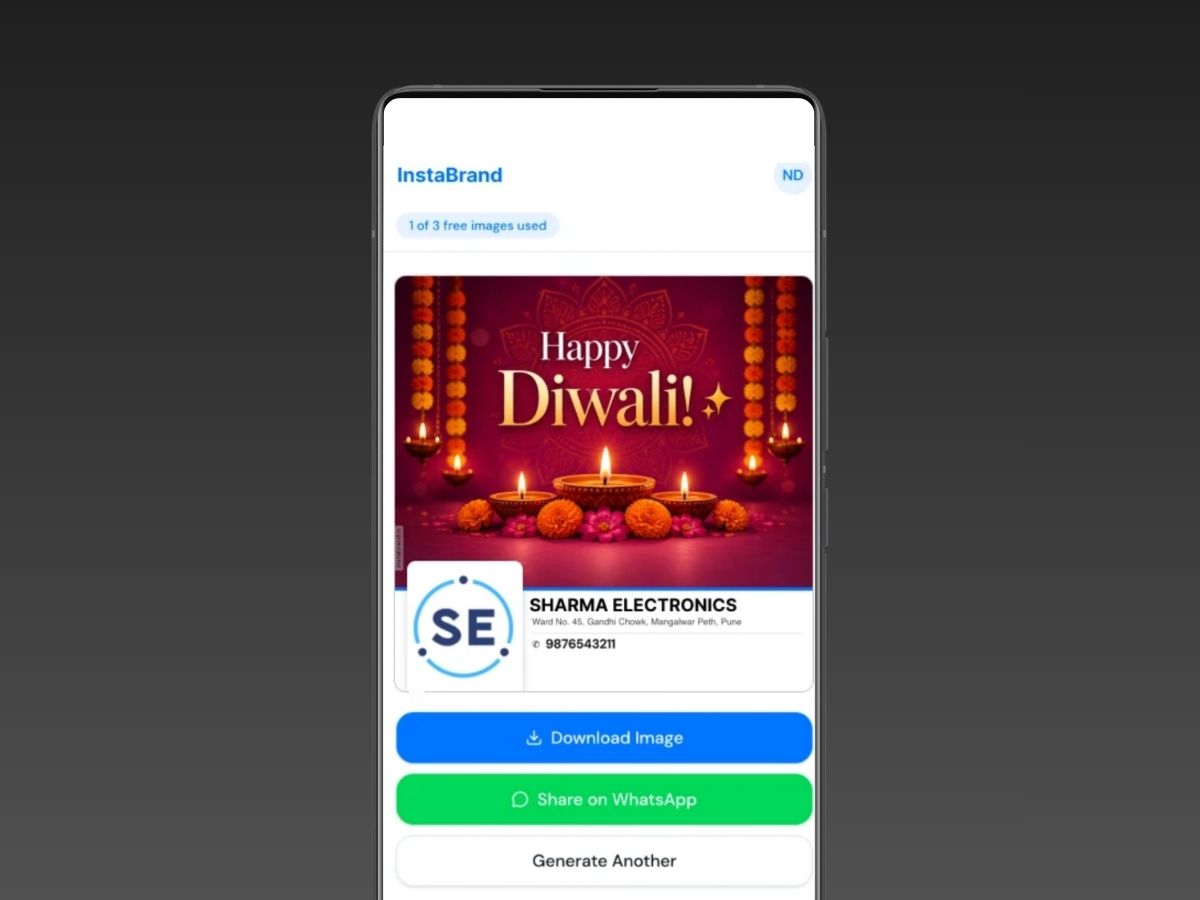
Generated output
The final generated output — brand, name, and contact composited automatically
Feedback that moved decisions, not feedback that got shelved.
Real conversations with real users directly reshaped the plan.
01
Wanted offers/products on the brand bar
Not just contact info — this is now a roadmap item.
02
Repeated requests for video output
For WhatsApp Status/Reels — scoped and sequenced.
03
Wanted SMS OTP, not email sign-in
Researched India's mandatory DLT registration before committing to a timeline.
04
No-preview setup left people guessing
Directly caused the two-step brand setup redesign.
05
Some users had no logo at all
Directly caused the text-based logo generator.
06
Not feedback collected and shelved
Real conversations with real users directly reshaped the plan — feedback that moved decisions.
Nothing relies on memory — the documentation is the source of truth.
Every choice, tradeoff, and deferred idea is written down — the discipline that let a solo build stay coherent across months of decisions.
- A living roadmap tracks what's built, what's parked, and why
- Deferred items carry explicit reasoning — e.g. a reliability fix held back until a real paying customer exists
- Pricing changes rejected in favor of holding steady through validation — written down, not just remembered
- Architecture decisions traceable back to the reasoning made at the time
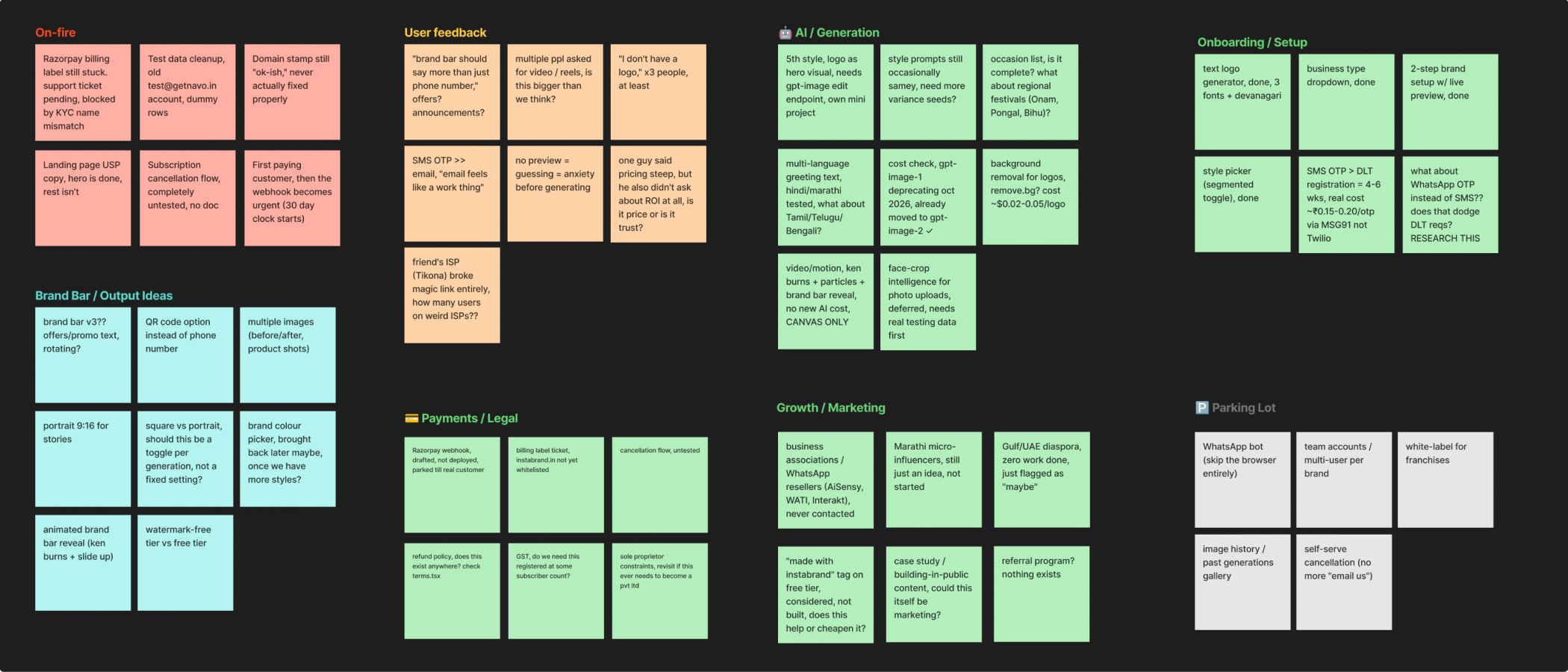
Sample roadmap / decision log excerpt
Deferred items, tradeoffs, and reasoning — written down, not just remembered
Live product. Pre-launch, not yet validated at scale — stated plainly.
The proof this case study offers: a product designer can think and build like a full-stack founder — defining the problem, architecting the system, directing AI to build it, designing the interactions, and listening hard enough to real users to let them change the plan. That range is the point.
Identified the underserved segment and defined the product thesis
Directed architecture and build using Claude and Lovable
Wired Razorpay, Supabase, Resend, and a two-model AI image pipeline
Designed the brand setup, style picker, and text-logo generation flows
Ran user conversations that directly reshaped the roadmap
Researched compliance requirements (India SMS/DLT) ahead of feature commitments
Owned product, strategy, design, and go-to-market — solo
Documented every decision, tradeoff, and deferred idea as the source of truth